

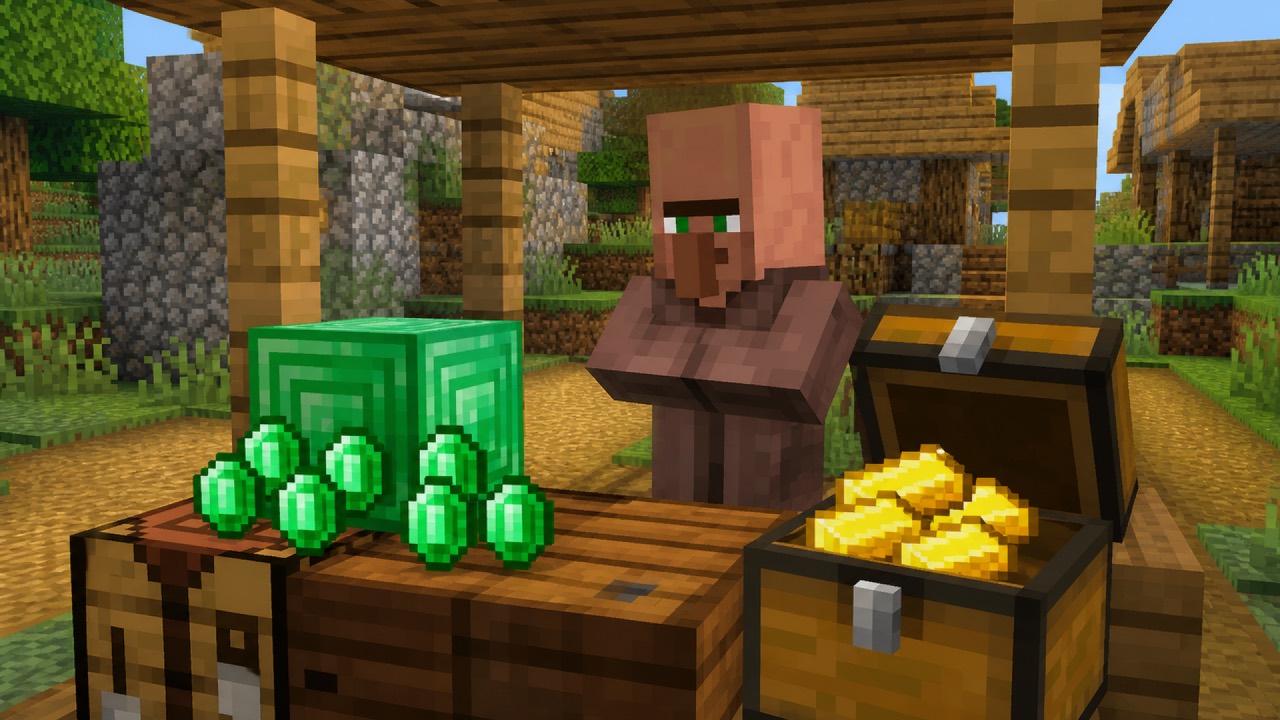
Wow #1 · Raid discount (Java)
30–55%
Hero of the Village trade cut after you win. Levels I to V on Java only.
Wow #2 · Same discount (Bedrock)
~30%
Bedrock Survival is level I only. No I–V ladder, no tossed gifts.
A labeled comparison: I match vanilla village systems to named real-world patterns, then show where each cousin breaks. Not a country ranking, not a faith ranking, and not a locked numbers panel like Minecoins or life expectancy.
Once you name the cousins (armed outsider, stall tokens, folk magic), the gaps get clear. Villagers do not vote or tax. Emeralds are stall money. Omens and relics are not Sunday church.
Vanilla village systems Wiki mechanics Named history pages
Related reading: how farmer prices actually move · what one emerald cashes out to in groceries · breed, cure, job sites.
1. What happens on a village afternoon?
You drink an ominous bottle (or, on older rules, walk in after killing a raid captain). Raid Omen ticks down.
A villager runs for the bell. On Java they ring it; on Bedrock the bells can ring themselves. Everyone else sprints to beds. An iron golem already wants a fight. You clear the waves.
Java may hand you Hero of the Village I–V. About 30% off at I, up to about 55% at V. Plus tossed gifts. Bedrock’s hero effect is level I only (~30%), with no gift rain.
Next morning the farmer still wants wheat for emeralds. The librarian still wants a lectern. Nobody voted. Nobody mailed you a tax bill. That loop (raid, bell, stall) is the “country” I compare.
Default Survival only. Creative is god-mode. Hardcore is the same town with one life. Minecoins on Bedrock are store money, not village money. I leave them aside.
2. Government · what country does it feel like?
Best cousin: an armed outsider beside a market town. Sometimes a protector, sometimes a predator. Call it a warlord without rent if you need a short label.
A real manor needs the key piece: peasants tied to land who owe rent or labor for protection.
Vanilla villagers do not tithe wheat to you. So “manor / feudalism” is a loose costume, not a win.
| Minecraft | Looks like | Example |
|---|---|---|
| You in diamond vs unarmed villagers | Armed outsider | Clear a pillager outpost, walk into town, and the stalls suddenly care about you. The town did not hire you. |
| Iron golem | Militia and guardian statue | Villagers spawn golems to patrol (Bedrock also generates one with the village). Same mob punches raiders and reads like a protective idol. |
| Gossip / popularity | Town temper | Hurt villagers and prices get worse; golems can turn on you. The town remembers without a court docket. |
| Village bell | Alarm, not a parliament | Raid warmup: cover, not debate. Java: a villager rings. Bedrock: bells can auto-ring. |
| Raid + Hero of the Village | War coupon | Win the waves → trade discount (Java I–V / Bedrock I). You did not win an election. |
| Illagers / pillagers | Rival raiding culture | Outposts, patrols, mansions. Armed, not a second village economy. |
| Wilderness night | Frontier / no-town zone | Leave the bell’s reach and “government” is you, a bed, and mobs. |
Where even the outsider analog breaks
- No oath, no tax roll, no manor dues. You extract surplus only if you trade or steal.
- No court. Game rules (and maybe a server admin) are the only law.
- You can delete the town. One lava bucket and the market is gone.
- Not a democracy. Vanilla villagers never vote. Players on some servers add votes on top.
- Not a modern welfare state. Hunger is your bar, not a ministry.
Classrooms sometimes add citizenship on top of Minecraft. For example Education’s Tale of Two Villages (villagers and illagers as neighboring communities). That is players writing extra government.
The base game still does not ship a city council. The separate Supply and Demand lesson is a market classroom, not a civics one.
3. Economy · what market does it feel like?
Best cousin: a job-block stall market paid in emerald tokens villagers accept. Plus a second money in the Nether (gold with piglins).
Like a guild in one way: one workstation ↔ one job, locked after the first trade. Not a real guild: no apprenticeship years, no quality board, no town politics.
Emeralds are not silver-style commodity money (money that also has big non-money uses, like jewelry). You can mine them, but the renewable engine is selling to villagers (wheat, sticks, rotten flesh…).
Villagers take the green gem by rule. No bank prints it. No non-money use keeps it scarce the way gold jewelry did.
| Minecraft | Looks like | Example |
|---|---|---|
| 13 professions ↔ 13 job blocks | Stall + workstation | Lectern → librarian. Composter → farmer. Break the block before any trade and the job can reroll. Nitwits never take a stall (Java). |
| Novice → Master badges | Deeper catalog, not a mastership exam | XP totals 0 / 10 / 70 / 150 / 250. Master unlocks more offers. It is not a CEO. |
| Emeralds | Token villagers accept | Dig veins or. More often late game. Farm trades. Same gem either way. |
| Demand + restock | Stall memory | Empty wheat every restock and 20 wheat per emerald becomes 36 after three dumps. Bread stays 1 emerald longer. Full formula. |
| Cure reputation / Hero discount | Favor + war coupon | Save a zombie villager and that villager likes your prices. Win a raid and the whole town cuts list. Floor is still 1 emerald. |
| Wandering trader | Caravan | Sells odd blocks for emeralds. You do not staff their shop. |
| Piglin barter | Foreign money | Nether trade wants gold, not emeralds. Same player, two currencies, two cultures. |
| Ignore the village | Homestead | Casual Survival: farm, mine, never speak to a villager. The market is optional. |
| Trading hall | Capturing every stall | Optimized play: beds + workstations + sometimes cure chains. That is not “free enterprise.” Name the playstyle. |
Where the stall analog breaks
- No wages. Villagers do not take home pay. They restock at the block.
- No firms, no banks, no interest. Anvil XP is a repair fee, not a loan.
- Not a planned state store. Nobody sets a wheat quota. Farmers just exist.
- Not modern capitalism. No ads, no companies, no stock. Just stalls and a green gem.
Grocery dollars for those emerald bags live in a different story. One emerald is worth very different grocery bags (~$0.12–$6 depending on the food window).
That is us forcing U.S. shelves onto village list prices, not a villager inflation index.
4. Ritual · what religion does it feel like?
Best cousin: omen-and-relic folk magic. Portents. Guardian figures. Dangerous temples. Relics after killing world-bosses. Plus enchanting as technique.
Not a denomination with scripture, a clergy ladder, and a weekly church service.
Vanilla has no sermons. The villager named “cleric” works a brewing stand that generates in village temples. Not every village building that looks church-like. That stall sells pearls, glowstone, and bottles o’ enchanting.
Apothecary stall in a sacred-looking shed, not a pastor.
Some living folk practice (amulets, local guardians, shrine precincts) rhymes with this bundle. That is not the same as saying Minecraft “is” any one modern religion.
| Minecraft | Looks like | Example |
|---|---|---|
| Bad Omen / Raid Omen | Portent that starts a war | Drink the ominous bottle (or older captain-kill rules), walk into town, countdown, raid. |
| Iron golem | Protective idol that also punches | Same as the militia row. Garrison and talisman in one mob. |
| Totem of Undying | Amulet / extra life relic | Hold it, don’t die once. No prayer text. Inventory slot. |
| Beacon + nether star | Monument after a death-boss | Kill the Wither, build a pyramid, pick Speed or Haste. Blessing from hardware. |
| Enchanting table + lapis | Workshop magic | Glyphs, bookshelves, random offers. Technique. Not a creed. |
| Nether | Fiery underworld biome | Lava, fortresses, soul sand, piglin gold. You can still build a house. Not a theology of damnation. |
| The End | Outer otherworld | Dragon, cities, elytra. Boss sky. Not a promised afterlife with rules for the living. |
| Ancient City / Warden | Taboo precinct | Silence or die. Sacred-feeling ground with a guardian. |
| Allay / vex | Helpful vs hostile spirits | One fetches items. The other is an evoker’s attack. |
Lazy matches I refuse
- “Nether = hell, therefore one world religion.” Player meme. No Satan, no salvation story, no commandment tablet. Fire Resistance picnics are allowed.
- “Respawn = karma / rebirth path.” Survival continue is a game rule. Hardcore deletes it. Neither is a precept.
- “Village church = weekly church service.” The temple’s key block is a brewing stand.
One sentence: Minecraft’s “religion” is omens you trigger, relics you hold, and worlds you portal into. That is closer to old omen magic (and some folk practice) than to a denomination that meets on a schedule.
5. What about multiplayer servers?
| World type | Closer analog | Why |
|---|---|---|
| Vanilla single-player village | Armed outsider + stall market | My default here. |
| Realm / friend server (one owner) | Private monarch | One person can whitelist, ban, and roll back the world. |
| Anarchy servers | Failed state / open wilderness | Grief is the weather. Trust is a bunker. |
| Towny / factions plugins | City-states / clan leagues | Players write extra law the base game never shipped. |
| Big minigame networks | Company park | House rules, cosmetics, queues. Not villager towns. |
6. Scorecard
| Question | Best cousin | Runner-up | Not a fit |
|---|---|---|---|
| Government | Armed outsider + market town (no rent) | Frontier wilderness (outside town) | Manor/feudal dues; liberal democracy; modern tax state |
| Economy | Job-block stalls + emerald tokens | Homestead (ignore town); piglin gold; trading-hall capture | Silver-style dug money; corporate capitalism; command store |
| Ritual | Omen-and-relic folk magic | Workshop enchanting/brewing; some living folk parallels | Denomination with scripture + weekly church service; Nether-as-hell meme |
“Best cousin” means several independent systems agree. It does not mean Minecraft secretly belongs to that century.
How I compared it
Vanilla Survival village loop only (Java-style professions, golems, raids, emerald trades, omens, dimensions, gossip). Not treated as vanilla government: Minecoins, mods, and laws players invent on servers.
Method: match game features to named checklists. A pattern is not a “win” if a key historical piece is missing (manor = rent/labor dues; silver-style money = big non-money use + mined consent money; congregation = scripture + scheduled worship).
History pages: Britannica: manorialism; Britannica: merchant guild; Britannica: money.
Profession count: 13 job-site professions (armorer through weaponsmith), plus nitwit / unemployed. Hero of the Village: Java I–V ≈ 30% + 6.25% per extra level → 55% at V; Bedrock Survival ≈ level I only (~30%). Same discount family as my supply-and-demand paper.
Classroom (not vanilla gov): Education Supply and Demand; Tale of Two Villages.
Full note: articles/data/minecraft-civilization-analogs/METHOD_LOCKED.md (v1.1.0).
