
Skip beds long enough
Phantoms
Flying Phantoms are the main sleepless danger in normal Minecraft.
If sleep loss followed real life
Nights 2–3
That is when play would first feel worse. Same timing Phantoms already use.
A what-if for mods, maps, and story ideas. Vanilla only adds Phantoms when you skip beds. I wanted to know how Survival would change if sleepless nights followed real-life tiredness instead. Not medical advice. Not a Mojang update plan.
Real sleep loss hits attention, aim, and judgment after only a few days awake. If Minecraft followed that, Survival would start to feel worse in the same early window Phantoms already use, not hundreds of Earth days later.
Skip the bed and you get Phantoms
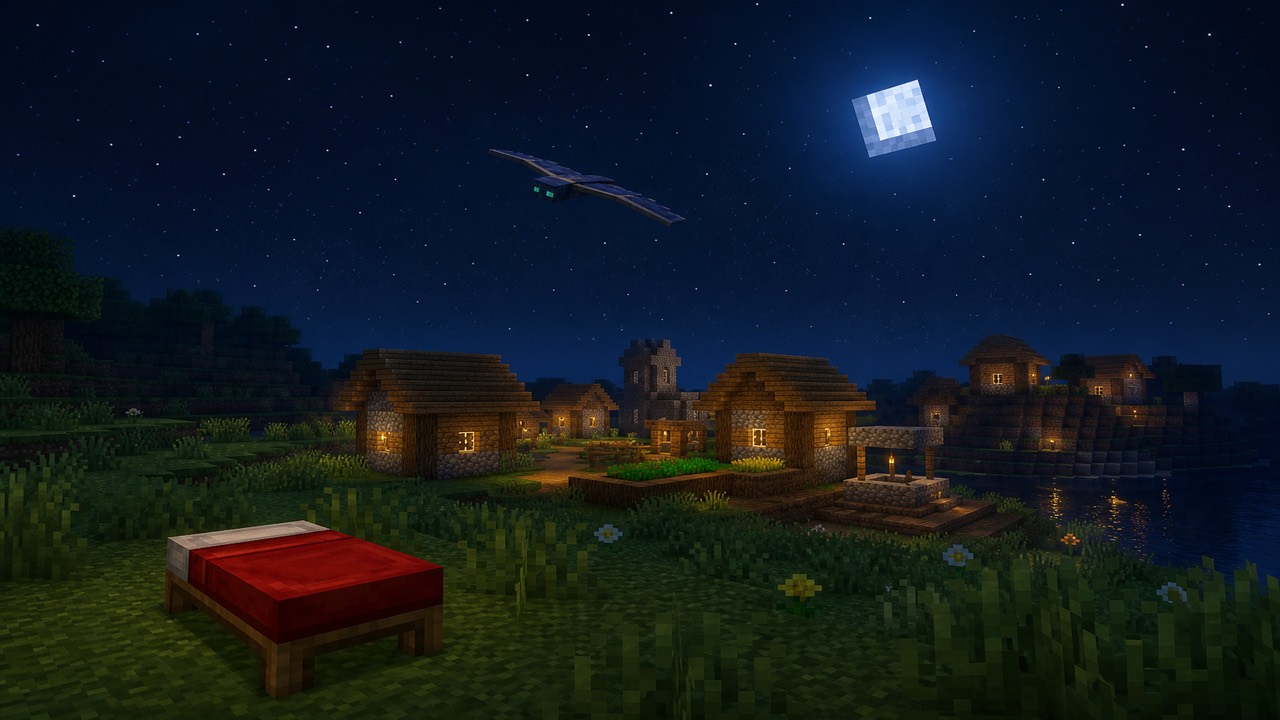
Night falls on a village, the bed is empty, and you keep mining anyway. A few nights later a Phantom, a hostile flying mob, drops out of the moonlit sky and dives at you. That is the sleepless story vanilla Minecraft actually tells.
Beds skip the night, set your spawn, and reset how long you’ve gone without rest. Stay up long enough and the only sleepless danger in the base game is those Phantoms. They can show up after about three Minecraft days without sleeping. Exact rules live on the wiki and can change by version and edition.
Fight them off and the character is otherwise fine. Full view, full attack speed, steady crafting. No growing blur, and no forced bad decisions. Vanilla treats sleeplessness as a world danger, not as a stack of player penalties.
I wanted to know how Survival would change if skipped sleep followed real life instead: blurry vision, slower swings, and worse choices.
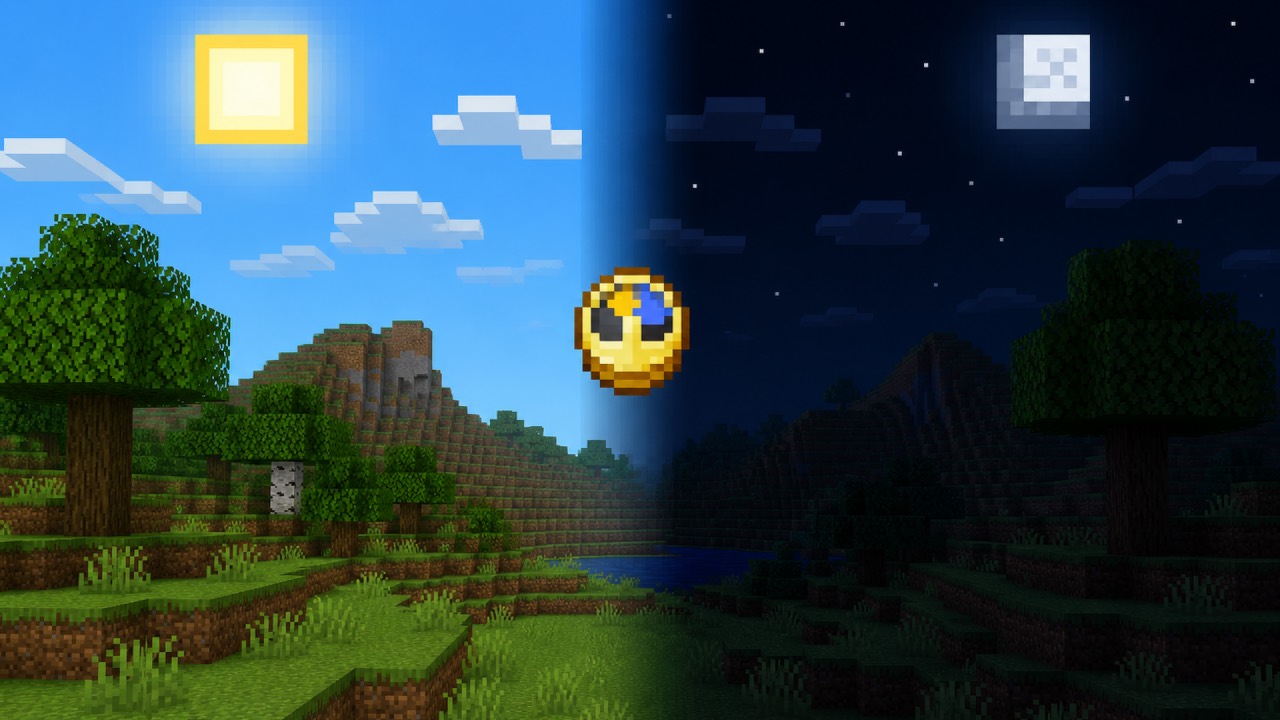
One Minecraft night awake counts as one day
Count one full Minecraft day-night cycle without a successful bed rest as one day awake. Real time is still about 20 minutes per full cycle if you do not skip the night.
Then the nights add up: night 1 is a little worse, night 3 is clearly worse, and night 6 and after is a horror story. Sleep in a bed and the counter resets, the same idea Phantoms already use.
One clock is real minutes since you launched the game. The other is in-world nights without sleep under the rule above. A speedrunner who never sleeps only spends real hours awake at the keyboard. This story is about Steve’s in-game nights, not your bedtime.
Nights 2–3 are when Survival would first feel worse
Researchers do not keep healthy people awake until they die. In plain terms: even one night of bad sleep can slow reactions, dull attention, and worsen judgment.
After about a full day awake, those drops get big. Some lab tests treat hands-and-timing tasks like moderate alcohol: slower reactions and harder aim.
For Survival, what matters is not a far-off calendar. It is when hard jobs start failing: mining near lava, parkour, combat timing, inventory choices under pressure.
Under this what-if, never-sleeping players would feel it by nights 2–3. Phantoms plus the first real control and attention problems. By nights 4–5, skilled combat and precise mining become unreliable. By nights 6–10, the run becomes a horror story even if the human at the keyboard is fine.
What gets worse night by night
Below is a made-up Survival plan for mods and maps. Read it like steps on a staircase: each sleepless night makes the next step harder. It is not a Mojang rule, and it is not a real human death schedule.
About one short night or one day with little sleep. In real life: attention dips, slower simple reactions. In Minecraft: barely felt. Maybe a tiny attack jitter or a soft screen “breathe.” Phantoms still off.
About 2–3 days awake. In real life: slower reactions, small memory slips, more mistakes. In Minecraft: Phantoms can show up (~3 days). Add mistimed jumps, 5–10% bow misses, crafting mis-clicks, and a short dark fade when you stop sprinting. This is the first step that would change how Survival feels.
About 4–5 days awake. In real life: clear slowdown in hands and timing; mood swings; risk of brief freezes (microsleeps). In Minecraft: camera drift, mining the wrong block, slower shield raises, 0.5–1.5 second input freezes.
About a week to a week and a half awake. In real life: harder thinking; many people still recover if they finally sleep. In Minecraft: fake Phantom shapes and footsteps, map glitches, inventory mistakes, wasteful pathing.
Beyond famous monitored stay-awake cases. Hard tasks are already nearly impossible. Cap the effects. Make rest almost required (chests hard to use, combat nearly unwinnable). Never add “died of no sleep.”
Remember: nights 2–3 are the first step that really changes play, and that matches when Phantoms already appear.
The screen would get harder to read
On nights 1–2, the screen would pick up soft dark edges, and caves would get harder to read (ore versus stone). On nights 3–5, hard turns would leave afterimage streaks, and hard landings would get short blackouts that make fall edges easy to misjudge. From night 6 on, particle “ghosts” that are not real would waste swings in empty air. Keep real Phantoms as honest threats so players can tell noise from a real fight.
Inventory swaps would get worse
Rare “bad swaps” would be annoying on purpose, not total random trash: an offhand torch becomes a bucket, or you eat raw food when cooked was intended. Villager trade screens would pick up a higher mis-click chance after night 4. Chat or coordinate books, if a server allows them, could swap digits as anti-teleport flavor. Optional risk-seeking bias after many sleepless nights belongs in story packs only, and should stay off in competitive modes.
Swings and mining would get sloppy
The attack cooldown still fills, but the hit jitters after night 2, so more creeper crits miss. Mining gets a slight aim wobble while you hold attack, which turns lava edges into attention checks. Building scaffolding slips more as nights stack, and Elytra rocket boosts risk a bad pitch after night 5.
Pair that with Hardcore death samples: falls and combat already end most logged Hardcore lives in hours. More tired nights make the same mistakes fail more often. They do not invent heart disease mid-run.
See also
There is no honest death day
Trusted sources share the same awkward truth. Nobody can honestly say healthy people die after an exact number of days without sleep.
The aging story’s day clocks (hundreds of Earth days of play) are calendar math. They are not a medical timer for “dies of no sleep.”
| Evidence | What it says | How to read it |
|---|---|---|
| Famous human stay-awake case | Randy Gardner stayed awake about 264 hours (~11 days) under medical watch. He recovered after sleep. | Shows a long stay-awake stretch can be survivable in a watched case. It is not a “die after X days” limit. |
| Fatal familial insomnia (rare brain disease) | Average about 18 months from first symptoms to death. Many cases fall around 7–36 months. | A rare disease that includes insomnia. Not a stopwatch for “how long can you stay awake on purpose.” |
| Lab rats kept from sleeping | In a classic lab setup, rats that got almost no sleep died or were put down when death looked close, within about 11–32 days. | Animal study only (Everson, Bergmann & Rechtschaffen, Sleep, 1989). The setup also stresses the rats, so it is not a clean “sleep only” clock. |
U.S. health guidance for adults ages 18–60: 7 or more hours of sleep per day. That is a health tip, not a death timer. Short sleep raises disease and crash risk over years. That is different from one short multi-day stay-awake test.
Scientific American’s expert summary still says the same thing: there is no proven fixed hour-count when total sleep loss becomes deadly. Multi-day stay-awake tests wreck thinking without proving “you die after day X.” Guinness stopped accepting sleep-deprivation records for safety.
- The continuous male lifespan clock on the aging page is ~388 Earth days. The famous ~11-day human wake case ended in recovery, not death.
- Rats that reached death or near-death in about 11–32 days still sit far below those lifespan clocks.
- Fatal familial insomnia lasts months to years. That is not a Survival game rule.
- In modern Minecraft, nights without sleep summon Phantoms. That is the only base-game sleepless hazard.
The ~388 / ~413 Earth-day lifespan clocks answer “how long would they live if one Minecraft day = one day of life?” Nights without sleep would already wreck hands and eyes long before those clocks mattered. Past the ~11-day famous human extreme, I stop making the what-if worse toward death. I do not invent a “died of no sleep” death cause.
Leave it off unless you want it
Leave it off by default in Creative and Spectator, and make it an optional setting in Survival. Hardcore+ can allow stronger brief freezes, but still no “died of no sleep” death, so it stays compatible with the base game. In multiplayer, sleeplessness should be per player, not whole-server, because beds already vote. Accessibility needs separate strength sliders for camera, input freeze, and fake-ghost layers.
If Minecraft followed real sleep loss, not only spawning Phantoms, the story would not wait hundreds of Earth days. Changes that matter in Survival belong in the first handful of sleepless Minecraft nights. Cap the what-if well short of any imagined death clock.
How I calculated it
Minecraft clock: one full day–night cycle without a successful bed rest counts as one day awake. That matches the aging paper’s “one Minecraft day = one life day” rule so the two stories can talk to each other. Real time is still about 20 minutes per full cycle if you never skip the night.
Vanilla baseline: public Minecraft Wiki rules for Sleeping and Phantoms. Phantoms can show up after about three Minecraft days without sleep (exact rules can change by version and edition).
What-if ladder: the night-by-night steps (blur, slow swings, bad swaps, freezes) are a design sketch for mods and maps. They are timed to real sleep-research timing in plain language: trouble often starts after about one to a few days awake, and I cap the story well before any invented death day.
Human evidence: I cite public sources only. Scientific American on long stay-awake cases, CDC sleep-need guidance, the classic rat sleep-deprivation study, and StatPearls on fatal familial insomnia. Those sources explain why I refuse a hard “die after an exact number of days” number. Full links are in Sources.
I do not invent a day when someone “dies after X days without sleep.” Human notes come from public sleep research. The Minecraft tiredness steps above are made up for story design. Skipping beds in-game does not equal that many real days awake for the person at the keyboard. This is not a claim that Mojang should ship this as-is.
Sources and adjacent reading
- “How Long Can Humans Stay Awake?” Scientific American (Gardner ~264 hours; no established lethal threshold for voluntary total sleep loss). scientificamerican.com/article/how-long-can-humans-stay/
- CDC. Adult sleep needs (ages 18–60, 7+ hours). cdc.gov/sleep/…
- Everson CA, Bergmann BM, Rechtschaffen A. Sleep deprivation in the rat: III. Total sleep deprivation. Sleep. 1989;12(1):13–21. DOI: 10.1093/sleep/12.1.13 · PubMed: 2928622
- Llorens F, et al. / StatPearls. Fatal Familial Insomnia (average duration ~18 months; range often 7–36 months). NCBI: NBK482208
- Public summaries of cognitive decline and hands-and-timing slowdown after sleep loss (attention, reaction time, judgment, microsleep risk). Use review-level sources when expanding for video.
- Minecraft Wiki: Sleeping · Phantom · Daylight cycle
- Companion: If Steve aged like a human, how long would he live? · Hardcore deaths vs real life