
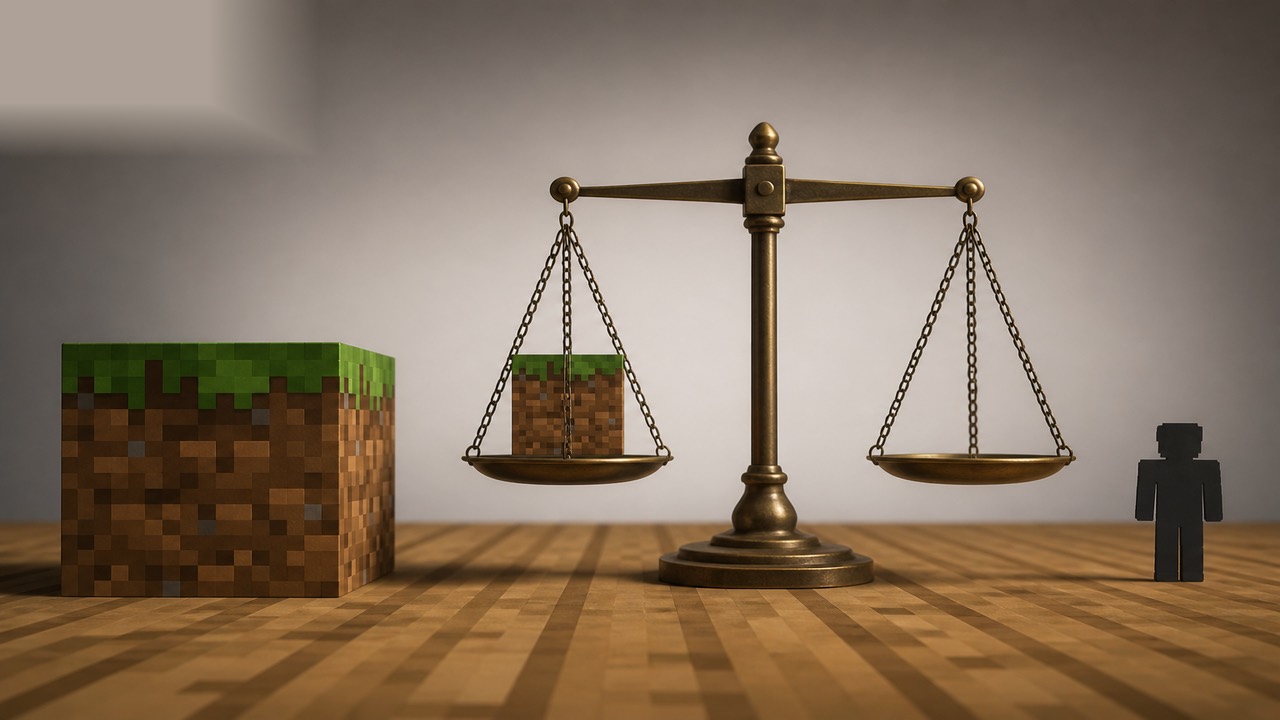
One gold cube
~19.3 t
One solid meter of elemental gold. Nearly two ~11 t school buses of metal.
One stone stack
~173 t
64 stones at a typical crust-rock density, already in blue-whale territory.
A what-if: treat each full block as a one-meter cube of a named real material. Minecraft never prints kilograms.
In Survival your pockets pretend tonnes don’t matter. On a real scale, a stack of stone would already be too heavy to carry.
A gold cube you can pick up with one hand
Place a gold block on the grass. Steve can pick it up with one hand. In Survival it sits in one inventory slot like a loaf of bread.
Minecraft never prints kilograms. If that cube were a real meter of gold, it would weigh about 19.3 tonnes. That’s nearly two school buses of metal in one block.
A stack of stone is already in blue-whale territory: about 173 tonnes for 64 cubes. A full bag of gold sits near 45,000 tonnes. The game never charges you for any of that mass.
Minecraft Education treats the world grid as one meter per block. Players are about two meters tall. I use that same meter cube for every tonne on this page.
Blocks on the scale
Start with the lightest story materials and work up to gold. A gold block is not just “expensive.” As a full meter cube of real gold, it is absurdly heavy. Confidence tags mark pure metals against looser stand-ins such as dirt or stone.
Mass of one full block
Tonnes per solid cube under locked stand-in densities. Crafted items appear later. Not in-game mass.
| Block | Real stand-in | Confidence | 1 block | Stack (64) |
|---|---|---|---|---|
| Oak log | Air-dry oak | Medium | 0.70 t | 45 t |
| Water | Liquid water | High | 1.00 t | 64 t |
| Dirt | Bulk soil | Low–medium | 1.40 t | 90 t |
| Stone / cobble | Crust rock | Medium | 2.70 t | 173 t |
| Diamond block | Solid diamond | High | 3.52 t | 225 t |
| Iron block | Elemental iron | High | 7.87 t | 504 t |
| Copper block | Elemental copper | High | 8.96 t | 573 t |
| Gold block | Elemental gold | High | 19.32 t | 1,236 t |
One stone stack (~173 t) is already in blue-whale territory. One gold stack is about 7.2× that stone stack, not twelve times. A “full bag” of gold (36 stacks) sits near 45,000 tonnes (exactly ~44,513 t under this density).
Locked densities put obsidian at 2.4 t per cube, lighter than stone (2.7 t) and glass (2.5 t). Blast-proof is not the same as heaviest.
Recipes on the scale
Open a crafting table and the icons still look light: three iron ingots and two sticks become a pickaxe you swing with one hand. For crafted items I do not invent a new measured volume for each icon. I take the game’s recipe and add a clear rule: ingredient masses add up to the product.
Minecraft says which items craft into what. It does not say each of nine gold ingots is exactly 1/9 of a solid gold meter. I use that equal split so storage recipes can talk in kilograms. Every badge below means my what-if, not a hidden Minecraft property.
Metal cubes pack cleanly
Nine gold ingots make one gold block. Under the what-if, each ingot is one-ninth of the cube’s mass.
Block of gold
3×3 gold ingots → 1 block
| Ingredient | Qty | Each | Line |
|---|---|---|---|
| Gold ingot | 9 | 2.147 t | 19.320 t |
| Combined ingredients | 19.320 t | ||
| Final · 1 × block of gold | 19.320 t | ||
Block of iron
3×3 iron ingots → 1 block
| Ingredient | Qty | Each | Line |
|---|---|---|---|
| Iron ingot | 9 | 875 kg | 7.874 t |
| Combined ingredients | 7.874 t | ||
| Final · 1 × block of iron | 7.874 t | ||
Wood keeps one log’s weight
Chop an oak log and craft it into planks. One log yields four planks, and each plank still places as a full block face. That breaks pure geometry almost immediately. Primary rule for tools and furniture here: one oak log’s 700 kg spreads across four planks. That way a pickaxe is not secretly four solid oak meters of free timber.
Oak planks
1 log → 4 planks
| Ingredient | Qty | Each | Line |
|---|---|---|---|
| Oak log | 1 | 700 kg | 700 kg |
| Combined ingredients | 700 kg | ||
| Final · 4 × oak planks (175 kg each) | 700 kg | ||
Sticks
2 planks vertical → 4 sticks
| Ingredient | Qty | Each | Line |
|---|---|---|---|
| Oak planks | 2 | 175 kg | 350 kg |
| Combined ingredients | 350 kg | ||
| Final · 4 × sticks (87.5 kg each) | 350 kg | ||
Pretend every placeable plank is still a 0.70 t solid oak meter, like the log. Then one log would produce 2.8 t of planks. That is 4× free matter. Tools below use the wood tree that keeps one log’s mass, not that free timber.
Tools that still feel light in the hotbar
If storage recipes and craft trees share my assigned masses, everyday tools jump into the tonne class. An iron pickaxe lands near 2.8 tonnes. An anvil lands near 27. That is a what-if result, not a Mojang printed weight. In the hotbar they still feel like toys.
Iron pickaxe
3 iron + 2 sticks
| Ingredient | Qty | Each | Line |
|---|---|---|---|
| Iron ingot | 3 | 875 kg | 2.625 t |
| Stick | 2 | 87.5 kg | 175 kg |
| Combined ingredients | 2.800 t | ||
| Final · 1 × iron pickaxe (what-if) | 2.800 t | ||
Reading: under the recipe-mass what-if, one iron pickaxe lands near 2.8 t. It is not a Minecraft fact on its own.
Anvil
3 iron blocks + 4 iron ingots (≡ 31 iron ingots)
| Ingredient | Qty | Each | Line |
|---|---|---|---|
| Block of iron | 3 | 7.874 t | 23.622 t |
| Iron ingot | 4 | 875 kg | 3.500 t |
| Combined ingredients | 27.122 t | ||
| Final · 1 × anvil (what-if) | 27.122 t | ||
Same iron map, larger craft. See also my short anvil vs gold cube note.
Netherite · gold-only lower bound
Netherite is the late-game metal you make from ancient debris (the rare Nether ore) and gold. Netherite ingots craft from 4 scrap + 4 gold; nine ingots pack a block. Scrap has no solid real-world twin I trust, so I do not invent a scrap density and call the result a finding. What I can say without that: the four gold ingots already carry known gold-ingot mass under my storage rule.
| Claim | Mass | Status |
|---|---|---|
| Gold contribution to one netherite ingot (4 gold ingots) | ~8.59 t | What-if · gold storage rule only |
| Gold contribution to one netherite block (9 ingots × 4 gold) | ≥ ~77.3 t | What-if lower bound · no scrap density assumed |
| Sensitivity · if scrap matched iron-ingot mass under 1/9 iron block | ~109 t total block | Optional “what if,” not a finding |
| Definite “netherite block = 167.6 t” (osmium-order scrap) | : | Not published as a result |
A what-if netherite block already hauls more than four meter-cubes of pure gold metal (~77 t) before scrap adds anything. That part is sturdy. It only leans on the same gold rule as the storage cube.
Selected what-if product masses
Crafted items under the recipe-mass what-if, plus the netherite gold-only lower bound (tonnes). Bars use a compressed scale so pickaxes and anvils can share a frame with gold. Read the numbers first.
| Label | Value |
|---|---|
| Oak log | 0.7 |
| Water | 1 |
| Dirt | 1.4 |
| Stone | 2.7 |
| Diamond block | 3.52 |
| Iron block | 7.87 |
| Copper block | 8.96 |
| Gold block | 19.32 |
See also
How many times body weight?
Fill your inventory with stone and the game never slows you down. Minecraft never charges for inventory mass. Under the density map I can still ask a simple what-if. If those cubes were real kilos in the main inventory (36 stack slots), how heavy is a hand stack or full bag versus an adult body?
I use one story number throughout: Steve ~152 lb (~69 kg). That is a mid-range healthy adult anchor locked in method. That is not a Mojang stat and not a medical claim about the character.
Multiples only compare real load mass to body mass. This is not a claim about bones, training, or injury.
| Load (real mass) | × body (~152 lb) |
|---|---|
| One stone / cobble block (2.7 t) | ~39× |
| One iron pickaxe (~2.8 t · what-if) | ~41× |
| One gold block (19.3 t) | ~280× |
| One stack of stone (64 · ~173 t) | ~2,500× |
| Full main inventory of stone (36 stacks) | ~90,000× |
| Full main inventory of gold | ~645,120× |
Multiple = load mass ÷ 69 kg. Inventory = 36 × 64 mono stacks (no armor/offhand, no shulkers).
One stone cube is about 39× body weight. One stack of stone is about 2,500×, and a full main inventory of stone is about 90,000×. Charts may compress that skyline into one frame. The multipliers above are the player-readable readout.
Body-weight multiples by load
Selected Survival loads under this what-if. Bars use a compressed scale so one stone cube and a full bag of gold can share a frame. Multipliers match the table (gold full bag = 645,120×). Read the table first.
| Label | Value |
|---|---|
| Stone block | 39 |
| Iron pickaxe (what-if) | 41 |
| Gold block | 280 |
| Stone stack (64) | 2500 |
| Stone full inventory | 90000 |
| Gold full inventory | 645120 |
What this isn’t
- Minecraft does not store item mass. These are what-if kilograms on a 1 m³ grid.
- Raw ore blocks are not pure metal cubes. I start from ingots, gems, and solid material blocks.
- Tool masses under the recipe-mass what-if are only as sure as the storage-split rule itself.
- Netherite has no published solid-element twin; gold-only lower bounds replace invented scrap densities.
- Shulker boxes and ender chests can nest storage forever; I ignore nested volumes here.
- Body-weight multiples use a story anchor for comparison. Not stress tests of bones or spines.
One ordinary stone cube is already ~40 body-weights. One stack is thousands. A full bag of stone is ~90,000×; a full bag of gold is 645,120×. In Survival the inventory pretends none of that mass is there.
How I calculated it
Minecraft never prints kilograms. I treat one full cube as 1 m³ of a named real material (Minecraft Education’s one-meter grid). Mass = density × volume.
Three layers stay separate. Minecraft fact: nine gold ingots craft one gold block; 64 items per stack; ~36 main inventory stacks for a “full bag.” Real-world fact: gold ~19.3 g/cm³. My what-if: nine storage units split a cube’s mass evenly; wood keeps log mass through planks and sticks.
Block-density map. Full cubes use locked densities (kg/m³): water 1000, ice 917, stone/cobble 2700 (crust-rock analogue), oak log 700 (air-dry oak order), coal block 1350, iron 7874, copper 8960, gold 19320, diamond block 3515, glass 2500, obsidian 2400, dirt 1400 (bulk soil analogue). Elemental metals follow handbook / RSC-order densities. Steve’s classic client height is about 1.8 m: almost two blocks.
Recipe-mass what-if. Reversible storage recipes. Nine iron/gold/copper/diamond craft into one storage block. Each unit receives one-ninth of that solid cube’s mass. Minecraft only establishes the craft shape; the equal mass split is mine. Crafted tools then sum ingredient masses (no extra volume invented for icons).
Wood tree. One log’s mass is split across four planks (plank = log ÷ 4). Sticks share that conserved wood mass. I do not treat four placeable plank blocks as four separate solid oak meters from one log (that would invent 4× free mass). An optional callout shows that absurd geometry model.
Netherite (gold-only lower bound). I do not assign a hard mass to netherite scrap. Under the gold storage rule, four gold ingots already contribute a known gold mass to each netherite ingot; nine such ingots therefore carry a gold-only lower bound into the netherite block. Iron-order scrap is an optional sensitivity, not a finding.
Comparisons. Adult ~70 kg; compact car ~1,400 kg; school bus ~11 t; blue whale ~150 t. Body-weight multiples use Steve ~69 kg (~152 lb) as a single story denominator (BMI 22.5 · CDC-order adult height in this method). Not biomechanics.
Mojang does not print these weights. Densities are real-world stand-ins for named materials (iron, gold, oak timber, crust rock). Ore blocks are out. Mixed rock plus veins need a grade I refuse to invent.
Sources & notes
- Minecraft Education: design / math materials describe world scale as one meter per block (see Education design guidance and math in Minecraft materials on education.minecraft.net).
- Minecraft Wiki. Block (1 m cells; solid height) and crafting pages for iron/gold/copper/diamond blocks, planks, sticks, tools, anvil, netherite ingot/block (Java shapes re-verified for these recipes): minecraft.wiki/w/Block.
- Royal Society of Chemistry Periodic Table: density at ambient conditions (g cm−3): gold 19.3, iron 7.87, copper 8.96 : Au, Fe, Cu. I lock kg/m³ as 19320 / 7874 / 8960 for table arithmetic. RSC-order iron is ~7.87 g/cm³; I keep 7874 (not a round 7875) so older notes match. Under Tier 2, one iron unit is therefore ~874.89 kg (7874÷9), not a clean 875.
- Diamond (solid) ≈ 3.51 g/cm³; water 1.000 g/cm³; ice / crust rock ~2.7 / air-dry oak ~0.7 and bulk soil analogues as method-labelled choices. Not pure elements and not ore grades.
- Player height ~1.8 blocks is the long-standing client model convention.
- Inventory carry count for “full bag” aggregates: 36 main stacks × 64 items (mono load).
- Body-mass anchor: BMI 22.5 at CDC-order adult height (~69 kg / ~152 lb). Comparison denominator only. CDC body-measurement summary: NCHS FastStats · Body measurements.